
The carrier behind a phone number is the single most underrated field in any lookup. It quietly answers questions that location and area code cannot: is this a real mobile line or a disposable virtual number? Why won't my verification code arrive? Is the "bank" calling me actually calling from a bank's infrastructure, or from a wholesale VoIP block that anyone can rent by the thousand? This page is a free carrier lookup tool and a complete guide to reading carrier data the way a telecom analyst does — including the honest limits of what carrier-of-record can and cannot prove.
What a carrier lookup tells you
Every North American prefix — the NPA-NXX, meaning the area code plus the next three digits — is assigned to exactly one operating company in NANPA's public Central Office Code records. This tool reads that record directly. Enter any US or Canadian number and it returns the holding carrier, whether the block is wireless, wireline or VoIP, and the rate center the block is anchored to. It is the same carrier field our full reverse phone lookup shows, isolated here for the moments when the carrier is the only thing you need: cleaning a lead list, debugging why an SMS won't deliver, or deciding whether an unexpected caller's claimed identity matches the infrastructure they're calling from.
Like every tool on this site, it runs entirely in your browser against a static data file. The number you type is never transmitted, logged, or stored, there is no account to create, and there is no per-lookup charge — unlike the commercial carrier-lookup APIs that meter the same underlying NANPA data by the query.
How carriers actually get their numbers
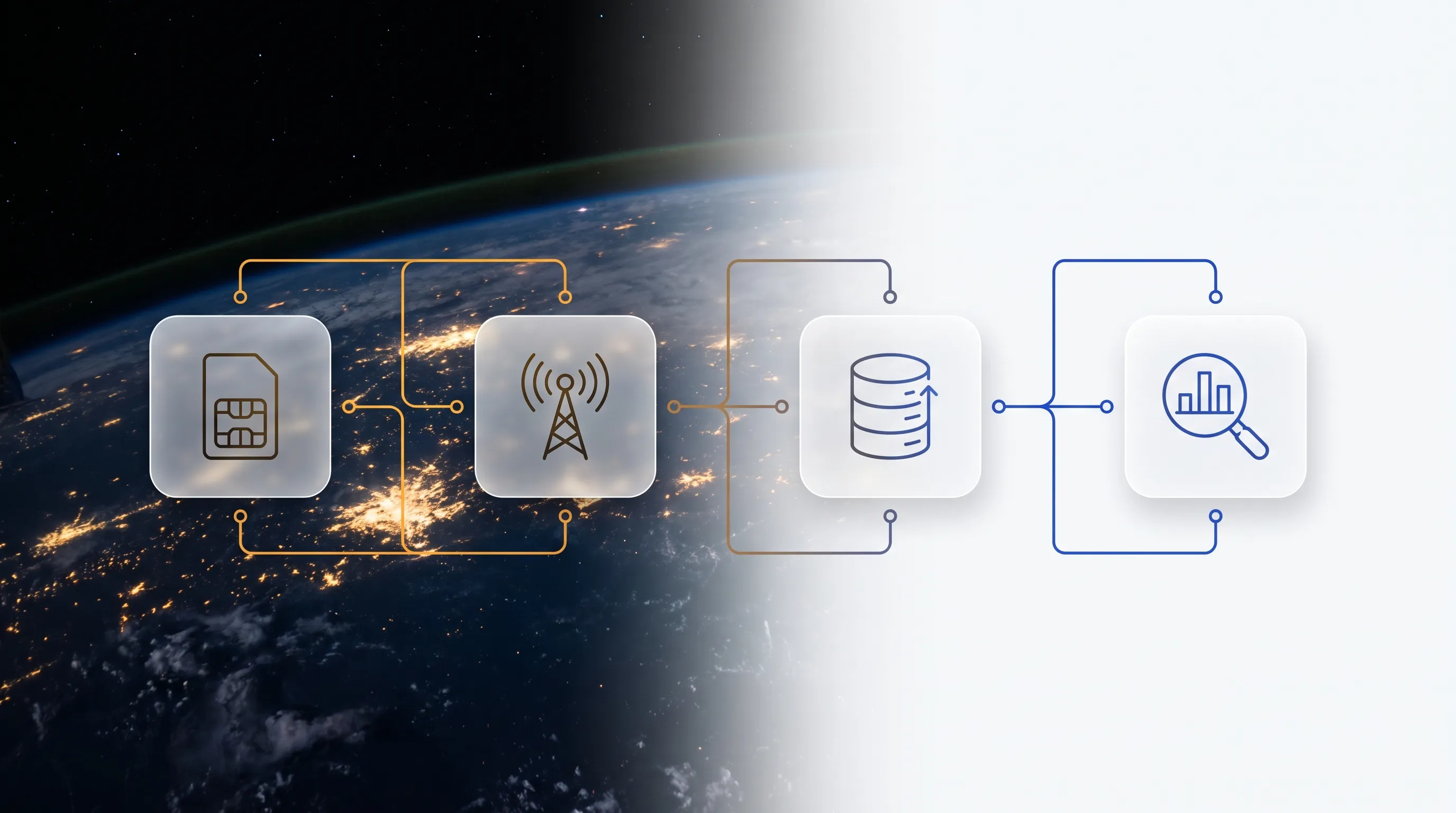
Understanding carrier data starts with understanding how numbers are handed out. NANPA allocates numbers to carriers in blocks — historically an entire prefix of 10,000 numbers, and since number-pooling reform, in thousand-number blocks to reduce waste. Each allocation is recorded against an OCN (Operating Company Number), the four-character code that uniquely identifies the carrier, plus the rate center, the geographic billing zone the block is anchored to. When you run a carrier lookup, the tool resolves the OCN attached to the number's prefix into a human-readable company name.
Two consequences follow, and both matter. First, because assignments are public, carrier results are verifiable — anyone can cross-check a result against NANPA's own published files. Second, because assignment happens at the block level, the record describes the block's original holder, not necessarily the provider serving one specific ported line inside it. That distinction is the source of nearly every "the carrier lookup was wrong" complaint, and it is not a bug — it is the honest limit of public data, explained in full below.
Reading carriers like an analyst
Carrier names fall into a handful of categories, and knowing which category you're looking at tells you far more than the specific company name.
Major wireless carriers
Verizon Wireless (often recorded as "Cellco Partnership"), T-Mobile USA, AT&T Mobility, and US Cellular hold the bulk of consumer mobile numbers. A number on one of these is an ordinary cell phone — the single most common and generally most trustworthy result. Note that the legal entity names in the records can look unfamiliar: Verizon appears as "Cellco Partnership DBA Verizon Wireless," and older AT&T blocks as "New Cingular Wireless PCS."
MVNOs — the resellers
Mint Mobile, Cricket, Boost, Metro by T-Mobile, Google Fi and dozens of others are MVNOs — Mobile Virtual Network Operators that resell capacity on the big networks. In carrier records their numbers often trace back to the underlying host network or to a wholesale intermediary rather than the retail brand, which is why a Mint Mobile number might show as T-Mobile and a Cricket number as AT&T. This is normal and not a sign of anything suspicious.
Regional and rural landline carriers (ILECs/CLECs)
CenturyLink (Lumen), Frontier, Windstream, TDS, and hundreds of small independent telephone companies hold genuine wireline blocks. A number on a regional telco carries the strongest location signal of any category — a landline physically terminates at an address inside its rate center, and rural telcos serve tightly defined territories. If you want to know where a number really rings, a small-ILEC result is as good as public data gets.
Cable-company voice
Comcast (recorded as "Comcast IP Phone"), Charter/Spectrum, Cox and others provide home phone service bundled with internet. These are residential lines, technically VoIP but tied to a physical home account, and are generally benign — the person who has your cable also has this phone number.
Wholesale VoIP carriers
This is the category that deserves the most attention. Onvoy (Inteliquent), Bandwidth.com, Twilio, Peerless Network, Level 3/Lumen wholesale, and similar operators hold vast blocks that they sub-assign to downstream apps and businesses. Their numbers power everything you'd want them to — app sign-up codes, clinic callback systems, legitimate startup support lines — and everything you wouldn't: robocall campaigns, scam boiler rooms, and disposable fraud numbers. A wholesale-VoIP result is not proof of anything bad, but it does mean the number is virtual, which raises the evidentiary bar for trusting an unexpected caller who claims to be your bank or a government agency.
A directory of major North American carriers
Carrier records use legal entity names that don't always match the brand on your bill. This reference maps the names you'll actually see in a lookup to the company you know, grouped by category, so you can interpret a result at a glance.
Major wireless networks
| Brand | How it appears in records | Notes |
|---|---|---|
| Verizon Wireless | Cellco Partnership DBA Verizon Wireless | Largest US wireless carrier by subscribers |
| T-Mobile | T-Mobile USA, Inc. | Absorbed Sprint in 2020; Sprint blocks now route here |
| AT&T Mobility | New Cingular Wireless PCS, LLC / AT&T Mobility | The "Cingular" name persists in older blocks |
| US Cellular | USCC / United States Cellular Corp. | Regional carrier, strong in the Midwest |
MVNOs and resellers (numbers trace to a host network)
| Brand | Host network |
|---|---|
| Mint Mobile, Metro by T-Mobile | T-Mobile |
| Cricket Wireless | AT&T |
| Boost Mobile | T-Mobile / AT&T (post-Dish) |
| Google Fi | T-Mobile / US Cellular |
| Visible | Verizon |
| Consumer Cellular, Straight Talk, Tracfone | Multiple hosts |
Landline and regional telephone companies
| Carrier | Type | Notes |
|---|---|---|
| CenturyLink / Lumen | ILEC | Large incumbent across many states |
| Frontier Communications | ILEC | Acquired many former Verizon landline territories |
| Windstream, TDS, Consolidated | ILEC | Regional incumbents, strong rural coverage |
| Comcast IP Phone, Charter/Spectrum, Cox | Cable voice | Home phone bundled with internet — residential |
Wholesale VoIP operators (virtual numbers)
| Carrier | What their numbers power |
|---|---|
| Onvoy / Inteliquent | App sign-ups, call centers, and a large share of robocall traffic |
| Bandwidth.com | Powers messaging/voice for many major apps (and their fraud) |
| Twilio | Developer platform — 2FA codes, notifications, and abuse |
| Peerless Network, Level 3/Lumen wholesale | Carrier-to-carrier wholesale voice |
Carrier names and OCN assignments: NANPA Central Office Code records. Brand-to-entity mappings reflect publicly known corporate structures and may change as carriers merge.
How to verify a carrier result yourself
One of the reasons to trust NANPA-derived carrier data is that you can check it against the source. NANPA publishes the Central Office Code assignment file publicly. To verify any US result: note the number's NPA-NXX (for example, 702-250), download the utilized-codes file for the relevant state from NANPA's reports, and find that prefix row. It will list the same OCN holder and rate center this tool shows, because they are the same records. We document this openly because a lookup you can independently verify is worth more than one you're asked to take on faith — a standard we'd like every phone-data service to meet.
Why there are so many carriers: a short history
If you're surprised by how many carrier names exist, the reason is regulatory. The Telecommunications Act of 1996 broke the local-phone monopolies open, creating a legal category of competitive local carriers (CLECs) alongside the incumbent ones (ILECs). Thousands of new companies obtained the right to hold number blocks. Two decades later, the rise of VoIP added another wave — software companies that route calls over the internet and hold their own numbering resources. The result is the sprawling carrier landscape you see today: a handful of giant wireless networks, a long tail of regional landline incumbents, and a growing middle of VoIP wholesalers. A carrier lookup is, in effect, a window into that entire structure, one number at a time.
Line type: physical versus virtual, and why fraud lives on VoIP
The carrier tells you the line type, and the line type is fundamentally a question of identity collateral — how much did this number cost its owner to obtain, in money, paperwork, and traceability?
| Line type | Tied to | Cost to obtain | Fraud association |
|---|---|---|---|
| Landline | A copper/fiber line at a street address | Requires physical service at a real address | Low — expensive and traceable |
| Mobile | A SIM and its subscriber | Requires a SIM; ID checks vary | Medium — burner SIMs exist but cost effort |
| VoIP | Software — nothing physical | Instant, bulk, pennies each, from anywhere | High — the default infrastructure of robocalling |
None of this makes VoIP villainous — half the customer-service lines you already trust are VoIP. The point is the asymmetry of evidence: a landline result carries real information about a real place and a real account; a VoIP result carries almost none. Calibrate your trust to that asymmetry, especially when the conversation turns to money. For the full breakdown of how the three line types behave, see the line-types chapter on the homepage guide.
Number portability: why the carrier may be "wrong"
Since the early 2000s, US and Canadian consumers have been able to keep their phone number when they switch providers — local number portability. This is a consumer win and a lookup complication. When you port your Verizon number to T-Mobile, the number's block record often still shows Verizon as the assigned carrier, because the block was allocated to Verizon and only your individual line moved. A carrier lookup that reads the block record will therefore show Verizon — the carrier of origin — not T-Mobile, your current provider.
For most purposes this is fine: you usually care about the number's character (real mobile vs. virtual, which network family, which region) rather than precisely which retail brand bills it this month. Only real-time telecom systems that query the live portability database (the NPAC) can name the current provider of a specific ported line, and that data isn't part of the free public record. When precision to the current carrier matters — for example, telecom routing — treat the free lookup as "carrier of origin" and use a paid HLR/portability query for the live answer.
Carriers, texting, and why your verification code won't arrive
Carrier data quietly governs SMS. Bulk-messaging platforms route and price texts by destination carrier, and many services deliberately block VoIP-held numbers from receiving one-time passcodes, because fraudsters favour disposable virtual numbers for creating fake accounts at scale. If you've ever wondered why a bank or app refused to send a verification code to your Google Voice number, the carrier is the reason — the number resolves to a VoIP wholesaler, and the service's fraud rules rejected it. A carrier lookup confirms this instantly: if your number shows Bandwidth, Twilio or Onvoy rather than a wireless carrier, that's why the codes bounce.
When a carrier lookup is the right tool
- Vetting an unexpected caller. "Chase fraud department" calling from a wholesale VoIP block registered nowhere near a bank is a contradiction worth acting on.
- Cleaning a contact or lead list. Knowing which numbers are landline vs. mobile vs. VoIP shapes how (and whether) you can legally text or robocall them.
- Diagnosing SMS delivery. A VoIP carrier result explains failed OTP delivery in seconds.
- Judging a marketplace seller. A week-old virtual number behind a "local" seller reads very differently from an established mobile with history.
- Understanding your own number. Looking up a number before accepting it from a carrier reveals whether you're inheriting a recycled VoIP line with a spam reputation.
The honest limits of carrier data
A responsible carrier lookup is as clear about what it can't do as what it can. It cannot name the number's owner — that's private carrier data, not public record. It shows the carrier of origin, which for ported lines may differ from the current provider. It reflects the numbering plan at the time of the last data refresh, so a very recently ported or reassigned line may lag. And it applies to US and Canadian (+1) numbers; international carrier data comes from a different source with varying depth (covered on the by-country homepage chapter). Any service that claims to turn a phone number into a name and home address is combining it with a separate people-search database and usually charging for the privilege — see our homepage explainer on why no free tool can honestly do that.
CNAM: the caller-name system, and why it's not a free name lookup
People often expect a carrier lookup to also reveal the caller's name, because their phone sometimes shows one. That name comes from CNAM — Caller ID Name — a separate system from the number-to-carrier record. Here's how it works: when a call comes in, the receiving carrier queries a CNAM database using the calling number and displays whatever 15-character name it finds. Crucially, the calling party's carrier controls what's stored, and CNAM databases are commercial, paid, and fragmented — there is no single authoritative one. This is why the same number can show different names on different networks, why many calls show no name at all, and why CNAM is trivially gamed by spoofers who set a trustworthy-looking name on a throwaway number.
For all these reasons, CNAM is not part of the free public record and is not a reliable identity source. A carrier lookup can tell you the number is a virtual VoIP line; it cannot hand you the verified legal name of whoever is using it. Any free service that promises a name for any number is either reading gameable CNAM data or, more often, routing you toward a paid people-search broker — a pattern our homepage explains in detail. Honest infrastructure data (carrier, line type, region, complaint history) is both more truthful and more useful than a spoofable name.
Toll-free numbers and RespOrgs
Toll-free numbers (800, 833, 844, 855, 866, 877, 888) don't have a geographic carrier in the usual sense. They're administered through the SMS/800 database and managed by RespOrgs — Responsible Organizations that control toll-free number assignment and routing. A toll-free number can be pointed to any underlying carrier and rerouted at will, which is part of what makes them flexible for legitimate businesses and attractive to scam operations that want a "professional-looking" callback line. Because a toll-free number carries no location and its routing can change, the only meaningful way to judge one is by its complaint history — which is exactly why the reverse phone lookup checks toll-free numbers against real FTC Do Not Call data and flags any that have been widely reported.
Using carrier data to catch a spoofed caller — a walkthrough
Here's how a carrier lookup turns into a practical fraud check. Suppose you get a call from a number displaying your own area code, and the caller says they're from your bank's fraud department, warning that your account is compromised and you must "verify" your details. Every instinct the scammer engineered is pushing you to act fast. Slow down and run the number.
Step one: check the carrier. If it resolves to Bandwidth, Onvoy or Twilio rather than to your bank's telecom provider or a recognizable carrier, you have a contradiction — real banks call from established, registered infrastructure, not from wholesale VoIP blocks that anyone can rent. Step two: check the line type. A "bank fraud department" on a disposable VoIP number is a strong tell. Step three: verify independently. Hang up and call the number printed on the back of your card. This three-step routine — carrier, line type, independent callback — defeats virtually every phone impersonation scam, because the scammer controls what your screen displays but not the infrastructure the number actually lives on, and not the number you choose to dial yourself. The Who Called Me? guide walks through the same routine for every common scam script.
Recycled numbers and what carrier data reveals
Phone numbers are a finite resource, so carriers recycle them. When a number is disconnected, it typically returns to the available pool after an aging period (often around 45–90 days) and is reassigned to a new subscriber. This is why your brand-new number might already receive calls for its previous owner — debt collectors, exes, spam lists that never got updated. A carrier lookup of your own number can be revealing here: if it shows a VoIP wholesaler and the number has a complaint history in the reverse phone lookup, you may have inherited a previously-abused line. Consumers can address this by registering on the Do Not Call Registry, using carriers' call-labeling correction portals, and asking lookup sites to review the number. Knowing the carrier is the first step in understanding a number's history.
Carrier lookup vs. reverse lookup vs. HLR — which do you need?
Three related tools get confused constantly. A carrier lookup (this page) reads the public assignment record to name the carrier of origin and line type — free, instant, block-level. A reverse phone lookup (our homepage tool) adds location, live local time and real spam-complaint history for the whole number. An HLR lookup (Home Location Register query) is a paid, real-time telecom query that pings the live mobile network to confirm whether a specific number is currently active and which network serves it right now — the only way to see past portability to the current provider of an individual line. For everyday questions — who's calling, is this a real mobile, why won't my code arrive — the free carrier and reverse lookups are all you need. HLR is for telecom operations and bulk validation, and it costs money per query.
Carrier call labeling: why your phone says "Scam Likely"
Carriers don't just hold your number — they increasingly judge the calls coming to it. Since 2021, US carriers have implemented STIR/SHAKEN, a framework that cryptographically signs calls so a receiving carrier can tell whether the originating carrier vouches for the displayed number. When a call fails that check, or matches a carrier's spam model, you see labels like "Scam Likely" (T-Mobile), "Spam Risk" or "Potential Fraud" (Verizon and AT&T). These labels are a carrier-level judgment layered on top of the raw number, and they've meaningfully reduced answered robocalls since rollout.
A carrier lookup complements this from the other direction. Where call labeling asks "should this incoming call be trusted?", a carrier lookup asks "what kind of number is this?" — and a wholesale-VoIP result on a number your carrier didn't flag is still worth caution, because labeling isn't perfect and spoofers migrate to gateways with weaker attestation. The two signals together are stronger than either alone. See the full spoofing and STIR/SHAKEN explainer for how attestation levels work and why some spoofed calls still slip through.
Business texting, A2P 10DLC, and carrier registration
If you run a business that texts customers, carrier data governs your life more than you may realize. Application-to-person messaging on standard 10-digit long codes — known as A2P 10DLC — now requires brand and campaign registration with the carriers via The Campaign Registry. Unregistered traffic gets filtered or blocked, and throughput is throttled by carrier trust score. This is why a carrier lookup matters for outreach: texting a landline is pointless (it can't receive SMS), texting a VoIP number may fail verification, and knowing the destination carrier mix shapes deliverability. It's also why legitimate brands text from consistent, registered short codes or 10DLC numbers rather than random mobiles — and why a brand suddenly texting you from an unregistered number is a phishing tell.
The major carriers in depth
Verizon
Verizon Wireless — recorded as "Cellco Partnership" — is the largest US wireless carrier by subscriber count, built on a network historically prized for rural coverage. Its consumer brand Visible and various prepaid lines all trace back to Verizon in carrier records. A Verizon result on a mobile number is about as ordinary and low-suspicion as a lookup gets. Verizon also retains large wireline territories, though many former Verizon landline regions were sold to Frontier, which is why a "Verizon" landline block in some states now serves Frontier customers — a portability-style lag baked into the corporate history.
T-Mobile
T-Mobile USA absorbed Sprint in 2020, so Sprint's former number blocks now belong to the T-Mobile family, and MVNOs like Mint Mobile, Metro by T-Mobile and (increasingly) Boost ride its network. T-Mobile pioneered aggressive free scam-blocking under its "Scam Shield" brand, including the #662# hard-block for "Scam Likely" calls. A T-Mobile carrier result is unremarkable for a consumer mobile; the brand's value for our purposes is that so many resellers trace back to it.
AT&T
AT&T Mobility appears in records under the legacy "New Cingular Wireless PCS" name from the mid-2000s Cingular era. Cricket Wireless, AT&T's prepaid brand, traces here too. AT&T runs its own call-labeling and blocking under the ActiveArmor brand. Like Verizon and T-Mobile, an AT&T result on a mobile is the expected, benign outcome — the signal that matters is when a caller claiming a national institution shows a carrier that is not one of these majors and not a recognizable regional telco.
International carrier data
Carrier lookup depth varies dramatically outside the +1 plan. Many countries publish operator prefix blocks that let a lookup name the network — Pakistan's mobile prefixes map cleanly to Jazz, Zong, Ufone and Telenor; Nigeria's to MTN, Glo, Airtel and 9mobile; India's to Jio, Airtel and Vi. Others publish carrier data at coarser granularity or not at all. Our international carrier data comes from a different public source than the NANPA file that powers US/Canada results, with country-by-country coverage documented in the by-country chapter of the homepage guide. Where a country has no public carrier data, a lookup still identifies the country, region and line-type character of the number.
Carrier lookup glossary
- OCN (Operating Company Number)
- The four-character code identifying a carrier in NANPA records. Carrier names are resolved from it.
- ILEC
- Incumbent Local Exchange Carrier — the established local phone company in a territory (e.g. CenturyLink). Landline results here carry the strongest location signal.
- CLEC
- Competitive Local Exchange Carrier — a company that entered local phone service after 1996 deregulation.
- MVNO
- Mobile Virtual Network Operator — a reseller (Mint, Cricket, Fi) riding on a big network's towers. Numbers trace to the host.
- Rate center
- The geographic billing zone a prefix block is anchored to — the "city" a lookup returns.
- Carrier of record
- The carrier a prefix block was assigned to. For ported lines this can differ from the current provider.
- LNP / portability
- Local Number Portability — the ability to keep your number when switching carriers, which is why block records can lag the live provider.
- VoIP
- Voice over IP — phone service delivered as software. Legitimate and everywhere, and also the default infrastructure of bulk robocalling.
- NPAC
- Number Portability Administration Center — the live database that tracks which carrier currently serves each ported number. Not part of the free public record.
Frequently asked questions
How do I find out what carrier a phone number is on?
Enter the number above. The tool reads NANPA's public Central Office Code records — the same assignment table carriers use for routing — and returns the operating company that holds the number's prefix, along with the line type and rate center. It works for any US or Canadian number without a sign-up.
Is the carrier always the current provider?
Not necessarily. NANPA records show the carrier a prefix block was assigned to. Since US and Canadian numbers are portable, an individual line may have moved to another provider while the block record stays with the original holder. For the block as a whole, accuracy is high; for a single ported line, treat the result as the "carrier of origin" rather than a guarantee of today's provider.
What does a wholesale VoIP carrier mean?
Names like Onvoy, Bandwidth, Twilio, Peerless or Inteliquent are wholesale operators whose numbers power apps and virtual phone services — Google Voice, call centers, two-factor SMS, and, unfortunately, telemarketing dialers. A VoIP holder on an unexpected inbound call is a caution signal, because virtual numbers are cheap to create in bulk and easy to discard.
Why does carrier matter for texting (SMS)?
Bulk-SMS platforms route and price messages by carrier, and many block VoIP-held numbers from receiving verification codes to cut down on fraud. Knowing the holder explains why a one-time passcode may never arrive on a Google Voice or other virtual number.
Can a carrier lookup tell me if a number is a cell phone or landline?
It can indicate the likely line type from the carrier of record — a block held by Verizon Wireless or T-Mobile is wireless; one held by a regional telephone company is wireline; one held by a VoIP wholesaler is virtual. Because ported individual lines can differ from their block, treat line type as a strong signal rather than an absolute. The phone validator and reverse lookup show it too.
What is an OCN?
OCN stands for Operating Company Number — a four-character code NANPA uses to identify each carrier in its records. When you see a carrier name in a lookup, it was resolved from the OCN attached to that prefix. OCNs are public, which is why anyone can verify a carrier result against NANPA's own files.
Why do so many numbers show "Onvoy" or "Bandwidth" as the carrier?
Because these wholesale VoIP operators hold enormous blocks of numbers that they sub-assign to thousands of downstream apps and businesses. A number showing Onvoy or Bandwidth isn't necessarily suspicious — it might be a legitimate startup's support line — but it does mean the number is virtual, which raises the bar for trusting an unexpected caller.
Is a carrier lookup free?
Yes. This tool is completely free, requires no account, and runs entirely in your browser — the number you enter is never sent to a server or logged. Many commercial "carrier lookup APIs" charge per query for the same NANPA-derived data; there is no reason to pay for a basic carrier-of-record check.